
Dust Guard – bulk material dust suppressor
Why so much dust?
Every time bulk material is loaded or unloaded, dust is created. The patented Dust Guard concentrates it inside the falling product and makes an additional aspiration system unnecessary.
5
Sizes
DG 40 – DG 150
2
Versions
Automatic & manual
641 m³/h
Maximum capacity
with DG 150
3
Material options
Steel, stainless steel, HARDOX
The challenge
A familiar problem, solved mechanically
Dust clouds during loading are no minor issue: they cost product and put a strain on the environment and equipment. The Dust Guard acts exactly where the product falls.
The problem
Uncontrolled dust formation
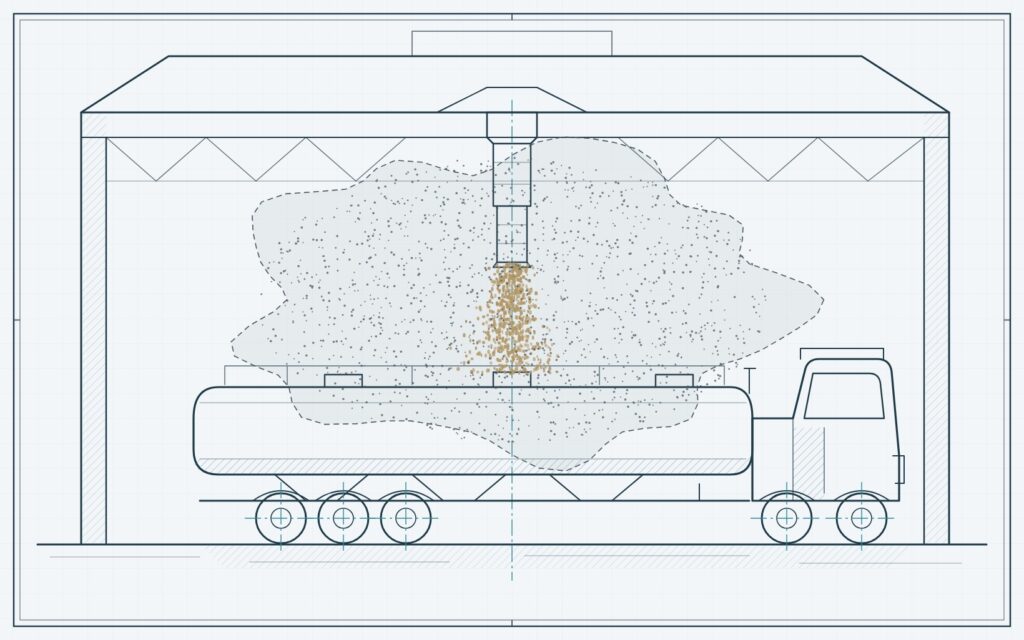
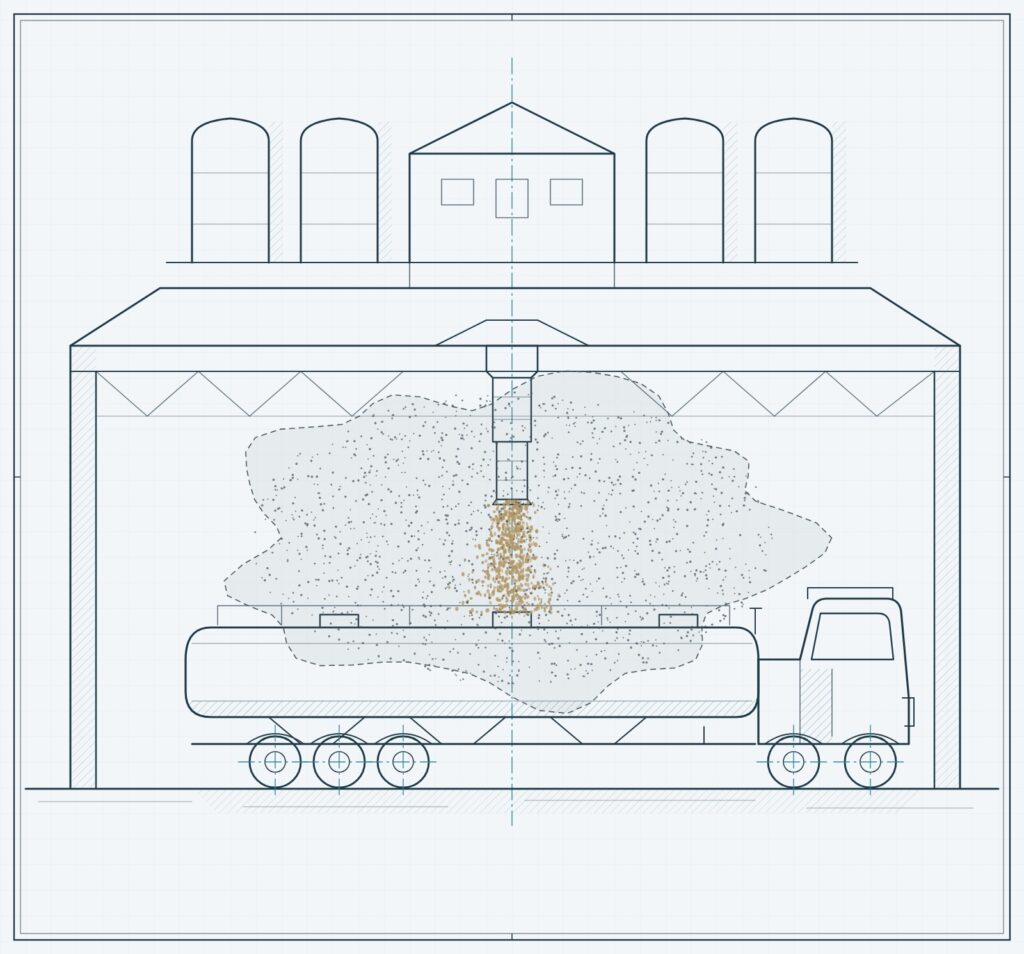
As bulk material falls freely, fine dust is stirred up and spread into the surroundings, clearly visible on the vehicle, the building and the area around it.
The solution
Dust Guard in operation
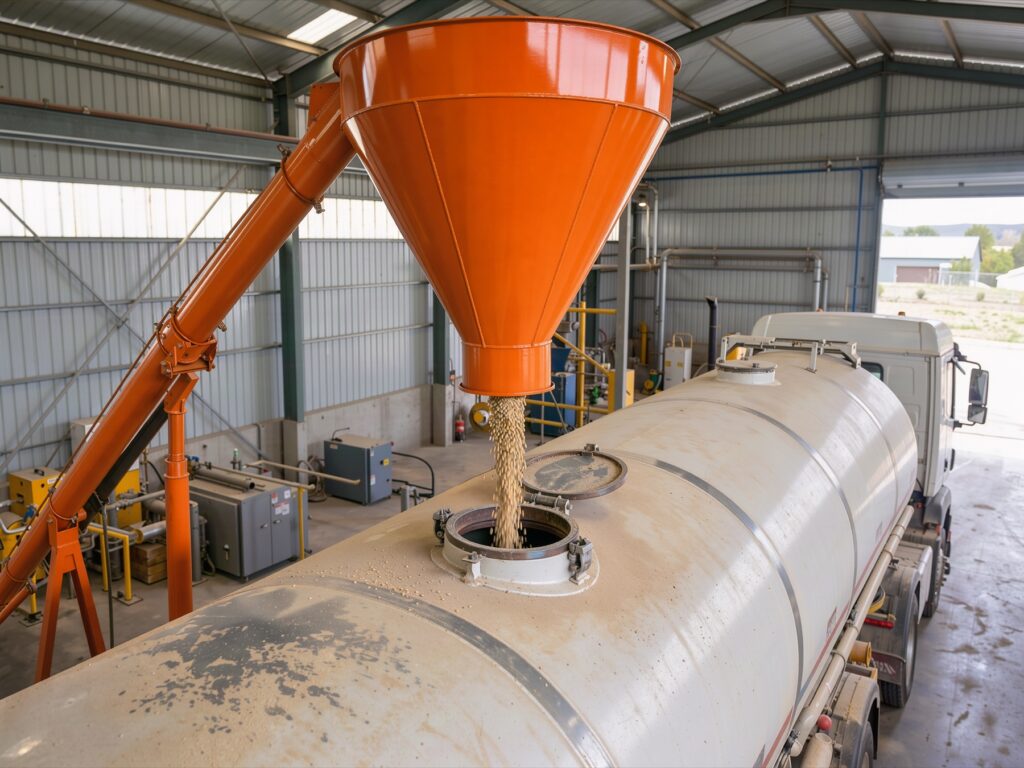
The dust is concentrated in the core of the falling product stream and falls together with the product, with no additional extraction at all.
Operating principle
How the Dust Guard binds dust as it falls
The dust suppressor can be used for any loading or unloading process with heavy dust formation, which means aspiration systems are no longer required. The patented operating principle concentrates the dust inside the falling product and thus minimises it purely mechanically, without filters, power or maintenance.
- The funnel shape guides the product stream towards the centre
- Dust collects in the core of the stream instead of spreading sideways
- Dust and product leave the Dust Guard together, no separate exhaust system needed
Design
Robust standard design, flexibly expandable
Standard design
- Painted steel construction
- Inspection window for product control
- Filter connection
Available as options
- Stainless steel construction
- HARDOX construction
- Vent
- Full-level indicator
- Pneumatic adjustment of the loading capacity
Specifications
Technical data
Capacity, weight and dimensions of all sizes. DG‑A and DG‑M have identical dimensions.
| Model | Capacity m³/h | Full weight kg | Volume dm³ | A mm | B mm | C mm | D mm | E mm |
|---|---|---|---|---|---|---|---|---|
| A DG 40 | 45 | 60 | 50 | 590 | 150 | 460 | 200 | 200 |
| M DG 40 | 45 | 60 | 50 | 590 | 150 | 460 | 200 | 200 |
| A DG 60 | 128 | 160 | 164 | 835 | 255 | 660 | 250 | 250 |
| M DG 60 | 128 | 160 | 164 | 835 | 255 | 660 | 250 | 250 |
| A DG 75 | 256 | 250 | 260 | 950 | 280 | 820 | 300 | 300 |
| M DG 75 | 256 | 250 | 260 | 950 | 280 | 820 | 300 | 300 |
| A DG 100 | 385 | 700 | 738 | 1280 | 380 | 1155 | 400 | 400 |
| M DG 100 | 385 | 700 | 738 | 1280 | 380 | 1155 | 400 | 400 |
| A DG 150 | 641 | 950 | 1900 | 1725 | 500 | 1570 | 450 | 450 |
| M DG 150 | 641 | 950 | 1900 | 1725 | 500 | 1570 | 450 | 450 |
A = automatic (DG‑A) · M = manual (DG‑M)
Available in two versions
DG‑A or DG‑M, depending on the application
Both versions are based on the same mechanical principle. The difference lies in how the falling stream is controlled.
Automatic
DG‑A
For products with different specific weights, the falling stream is regulated automatically by an electrical control system.
Optical sensors · Pneumatic slide gate · Control cabinet
Manual
DG‑M
For the same product with several loading points, the falling stream is set manually.
Simple mechanical adjustment
Frequently asked questions about the Dust Guard
What is the Dust Guard?
The Dust Guard is a patented bulk material dust suppressor by Wagner Feedmill. It is installed at the loading point and binds the dust created when bulk material is loaded or unloaded within the falling product stream.
How does the Dust Guard work?
The funnel shape guides the product stream towards the centre. The dust collects in the core of the falling stream instead of spreading sideways and leaves the Dust Guard together with the product.
Is an additional aspiration system required?
No. Because the dust stays in the product stream, no additional aspiration or exhaust system is needed. A filter connection is included as standard.
Which sizes and capacities are available?
There are five sizes: DG 40 (45 m³/h), DG 60 (128 m³/h), DG 75 (256 m³/h), DG 100 (385 m³/h) and DG 150 (641 m³/h).
What is the difference between DG-A and DG-M?
On the DG-A, an electrical control system with optical sensors, a pneumatic slide gate and a control cabinet regulates the falling stream automatically. This suits products with different specific weights. The DG-M is set manually and suits the same product at several loading points. Both versions have identical dimensions.
What material is the Dust Guard made of?
Painted steel as standard. Stainless steel or HARDOX are available as options.
Consultation
Is the Dust Guard right for your plant?
We size the right model and version for your throughput. Get in touch with us directly.
Wagner Feedmill & Silo Plants GmbH
Haßkamp 7
49688 Lastrup · Germany
Phone: +49 4471 / 70 16 568
Fax: +49 4471 / 70 16 569
contact@wagner-feedmill.de
